
Note
Go to the end to download the full example code.
Simple arctan fit#
Fit an arctan function.
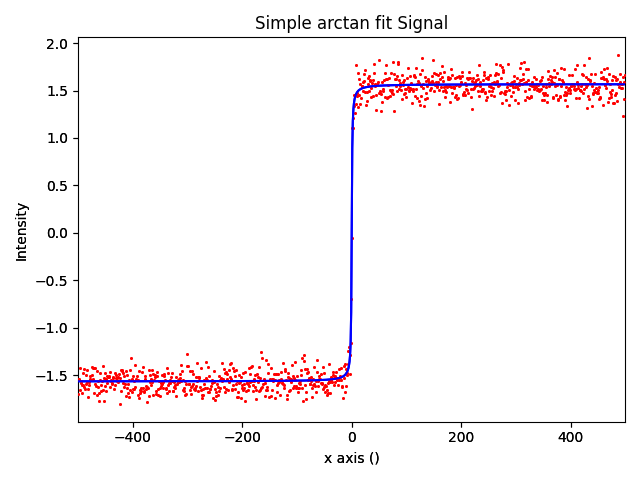
Model1D: Simple arctan fit
Arctan: Arctan
Active: True
+----------------+---------+------------+------------+------------+------------+--------+
|      Parameter |    Free |      Value |        Std |        Min |        Max | Linear |
+----------------+---------+------------+------------+------------+------------+--------+
|              A |    True |    0.99987 |   0.002088 |            |            |   True |
|              k |    True |     0.9338 |    0.07463 |            |            |  False |
|             x0 |    True |   0.012464 |   0.080518 |            |            |  False |
+----------------+---------+------------+------------+------------+------------+--------+
import numpy as np
import hyperspy.api as hs

# Generate the data and make the spectrum
data = np.arctan(np.arange(-500, 500))
s = hs.signals.Signal1D(data)
s.axes_manager[0].offset = -500
s.axes_manager[0].units = ""
s.axes_manager[0].name = "x"
s.metadata.General.title = "Simple arctan fit"
s.set_signal_origin("simulation")

s.add_gaussian_noise(0.1)

# Make the arctan component for use in the model
arctan_component = hs.model.components1D.Arctan()

# Create the model and add the arctan component
m = s.create_model()
m.append(arctan_component)

# Fit the arctan component to the spectrum
m.fit()

# Print the result of the fit
m.print_current_values()

# Plot the spectrum and the model fitting
m.plot()
Total running time of the script: (0 minutes 0.558 seconds)