
Note
Go to the end to download the full example code.
Implementation of a model supporting convolution of components#
This example illustrates how to implement a model supporting convolution.
Note
Model convolution has only been tested for 1D signals.
import hyperspy.api as hs
import numpy as np
Model class implementation#
Create a model class subclassing hyperspy.models.model1d.Model1D.
The subclass needs to implement the following API:
_convolution_axis_signal_to_convolveconvolved
The steps of how the convolution is implemented are explained in component convolution example.
from hyperspy.models.model1d import Model1D
from hyperspy.misc.axis_tools import calculate_convolution1D_axis

class ConvolvedModel1D(Model1D):

    def __init__(self, signal1D, detector_response=None, **kwargs):
        super().__init__(signal1D, **kwargs)
        self._convolved = False
        self._detector_response = None
        self._convolution_axis = None
        self.detector_response = detector_response
        self._whitelist.update(
            {
                "_convolved": None,
                "detector_response": ("sig", None),
            }
        )


    def _set_convolution_axis(self):
        """
        Set the convolution axis used to add padding before taking
        the convolution.
        """
        # Used during model fitting
        self._convolution_axis = calculate_convolution1D_axis(
            self.signal.axes_manager.signal_axes[0],
            self.detector_response.axes_manager.signal_axes[0]
        )

    @property
    def detector_response(self):
        return self._detector_response

    @detector_response.setter
    def detector_response(self, signal):
        if signal is not None:
            self._detector_response = signal
            self._set_convolution_axis()
            self._convolved = True
        else:
            self._detector_response = None
            self._convolution_axis = None
            self._convolved = False

    @property
    def _signal_to_convolve(self):
        # Used during model fitting
        return self.detector_response

    @property
    def convolved(self):
        # Used during model fitting
        return self._convolved
Example signal#
We create a signal of a Lorentzian convolved with a Gaussian function, where the Lorentzian function is the measurement of interest and the Gaussian function a model for a detector response.
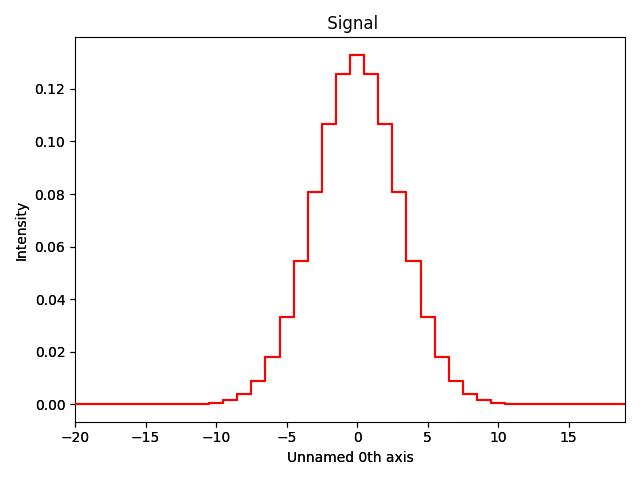
Generate a signal of the detector response:
g = hs.model.components1D.Gaussian(sigma=3)
g_signal = hs.signals.Signal1D(g.function(np.arange(-20, 20)))
g_signal.axes_manager.signal_axes.set(offset=-20)
g_signal.plot()
Generate an example signal using the same approach as in the implementation of a convolution for model fitting (see component convolution):
f = hs.model.components1D.Lorentzian(centre=220)
f_signal = hs.signals.Signal1D(f.function(np.arange(200, 300)))
f_signal.axes_manager.signal_axes.set(offset=200)
convolution_axis = calculate_convolution1D_axis(
    f_signal.axes_manager.signal_axes[0], g_signal.axes_manager.signal_axes[0]
    )
f_padded_data = f.function(convolution_axis)
f_signal.data = np.convolve(f_padded_data, g_signal.data, mode="valid") + 10
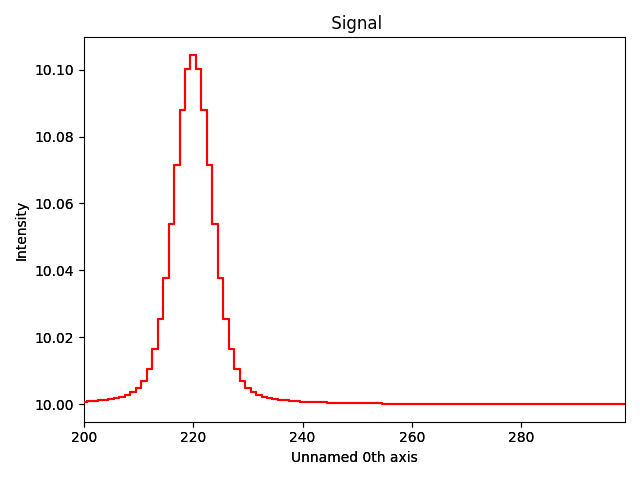
Plot signal composed of the convolution of a Lorentzian and a Gaussian function:
f_signal.plot()
Fit model with convolution#
m = ConvolvedModel1D(f_signal, detector_response=g_signal)
lorentzian_component = hs.model.components1D.Lorentzian()
lorentzian_component.estimate_parameters(f_signal, 200, 300)
offset_component = hs.model.components1D.Offset()
m.extend([lorentzian_component, offset_component])
The component of the model can be set to be convolved or not during model fitting. Specify that the Lorentzian is convolved:
lorentzian_component.convolved = True
offset_component.convolved = False
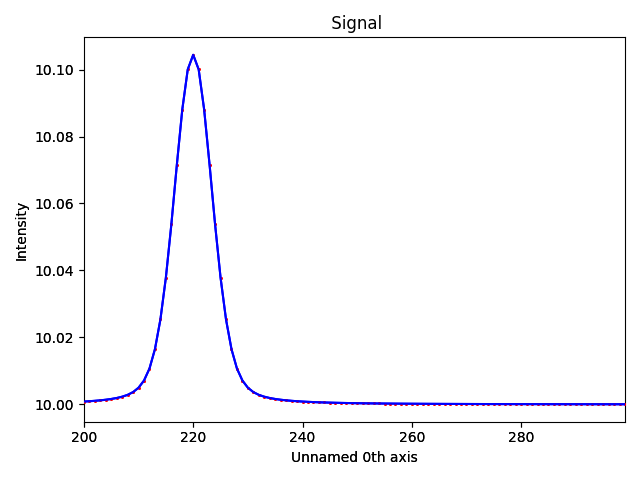
Show the results
m.fit()
m.print_current_values()

m.plot()
ConvolvedModel1D:
Lorentzian: Lorentzian
Active: True
+-----------+------+-------+-----+-----+-----+--------+
| Parameter | Free | Value | Std | Min | Max | Linear |
+-----------+------+-------+-----+-----+-----+--------+
|         A | True |     1 |   0 |   0 |     |   True |
|    centre | True |   220 |   0 |     |     |  False |
|     gamma | True |     1 |   0 |     |     |  False |
+-----------+------+-------+-----+-----+-----+--------+
Offset: Offset
Active: True
+-----------+------+-------+-----+-----+-----+--------+
| Parameter | Free | Value | Std | Min | Max | Linear |
+-----------+------+-------+-----+-----+-----+--------+
|    offset | True |    10 |   0 |     |     |   True |
+-----------+------+-------+-----+-----+-----+--------+
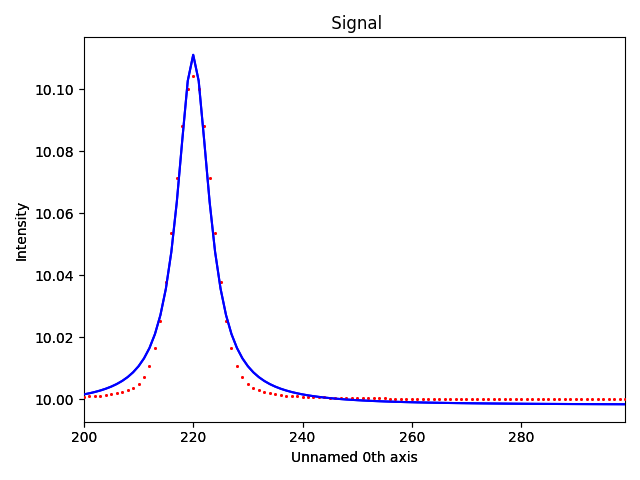
Fit model without convolution#
m2 = ConvolvedModel1D(f_signal)
lorentzian_component2 = hs.model.components1D.Lorentzian()
lorentzian_component2.estimate_parameters(f_signal, 200, 300)
offset_component2 = hs.model.components1D.Offset()
m2.extend([lorentzian_component2, offset_component2])

m2.fit()
m2.print_current_values()

m2.plot()
ConvolvedModel1D:
Lorentzian: Lorentzian
Active: True
+-----------+------+--------+----------+-----+-----+--------+
| Parameter | Free |  Value |      Std | Min | Max | Linear |
+-----------+------+--------+----------+-----+-----+--------+
|         A | True | 1.2522 | 0.023949 |   0 |     |   True |
|    centre | True |    220 | 0.054812 |     |     |  False |
|     gamma | True |  3.527 | 0.085845 |     |     |  False |
+-----------+------+--------+----------+-----+-----+--------+
Offset: Offset
Active: True
+-----------+------+--------+------------+-----+-----+--------+
| Parameter | Free |  Value |        Std | Min | Max | Linear |
+-----------+------+--------+------------+-----+-----+--------+
|    offset | True | 9.9982 | 0.00035862 |     |     |   True |
+-----------+------+--------+------------+-----+-----+--------+
Total running time of the script: (0 minutes 1.750 seconds)